Intermittent Explosive Disorder ICD-10: What F63.81 Means and When It Is Used
If you searched for intermittent explosive disorder ICD-10, you are probably trying to connect a plain-language concern about explosive anger with the medical code that may appear in records, claims, or clinical notes. In the U.S. ICD-10-CM system, intermittent explosive disorder is commonly represented by F63.81. That code can be useful to understand, but it is not a self-label or a shortcut to a clinical answer. It sits inside a larger evaluation process that considers behavior patterns, timing, context, safety, other conditions, and professional judgment. If you are trying to make sense of anger outbursts for yourself or someone close to you, an educational IED screening overview can be a calm first step for reflection before deciding what kind of support may be appropriate.
What F63.81 Means in ICD-10-CM
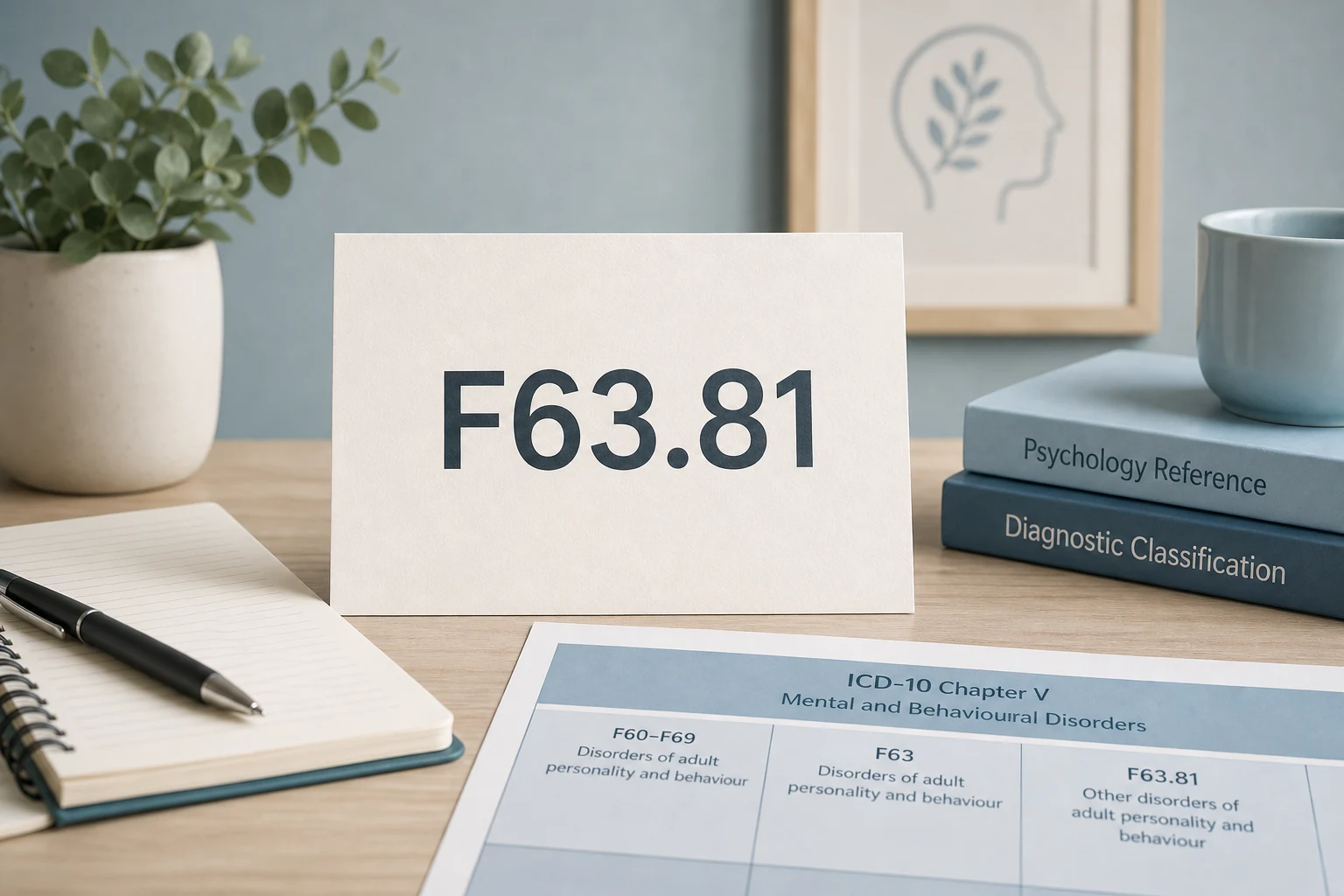
F63.81 is the ICD-10-CM code used for intermittent explosive disorder. ICD-10-CM is the U.S. clinical modification of ICD-10, so search results may say "ICD-10" while actually referring to the more specific U.S. code set. In everyday search behavior, phrases such as intermittent explosive disorder ICD-10 code, ICD-10 code for intermittent explosive disorder, and intermittent explosive disorder ICD-10-CM code usually point to the same practical question: what code is associated with IED in a U.S. medical coding context?
The code belongs within the broader mental, behavioral, and neurodevelopmental section and is grouped with impulse-control related conditions. In simple terms, it is connected with recurrent aggressive outbursts that are impulsive, out of proportion to the situation, and not planned for gain. The code itself does not tell the whole story. It does not describe severity, recent triggers, co-occurring concerns, safety risk, treatment needs, or whether another explanation better fits the person's situation.
That distinction matters because a code is a recordkeeping tool. It helps clinicians, coders, insurers, and health systems communicate in a standardized way. It is not meant to be used alone by a reader to decide what is happening. Someone may see F63.81 in a chart after a clinical evaluation, but the code is only one small piece of the reasoning behind care.
ICD-10 Criteria vs DSM-5 Criteria: What People Often Mean
Many people search for intermittent explosive disorder ICD-10 criteria, but that phrase can be a little misleading. ICD-10-CM provides codes and code labels. DSM-5 provides widely used clinical criteria in the United States for many mental health conditions, including IED. When searchers combine "intermittent explosive disorder DSM-5 ICD-10 code," they are usually trying to compare two different systems: one used for clinical description and one used for coding and documentation.
For IED, DSM-5 criteria focus on a pattern of recurrent aggressive outbursts, whether the reactions are disproportionate, whether they are impulsive rather than planned, whether they create distress or impairment, and whether the pattern is better explained by another mental health condition, substance effect, medical condition, or developmental stage. ICD-10-CM F63.81 gives the associated code, but the code does not replace a careful clinical interview.
This is also why a checklist found online can feel helpful but still be limited. It may help organize observations, yet it cannot weigh context the way a qualified professional can. Frequency, age, substance use, trauma history, mood episodes, attention problems, family stress, and safety concerns all affect interpretation.

When F63.81 May Appear in Adult Records
Searches such as ICD-10 code for intermittent explosive disorder in adult often come from people who have seen a term in paperwork or want to understand what a provider may be considering. F63.81 may appear when a clinician has evaluated a person's pattern of explosive outbursts and finds that intermittent explosive disorder is the most appropriate coded condition for that encounter.
In adult records, the surrounding notes matter. A useful record may describe the nature of outbursts, whether aggression is verbal or physical, how often episodes occur, whether property is damaged, whether the person regrets the behavior afterward, and whether the outbursts are causing relationship, work, legal, or safety problems. It may also include relevant history, such as when the pattern began and whether there is a history of intermittent explosive disorder ICD-10 coding in prior documentation.
The phrase intermittent explosive disorder unspecified ICD-10 can create confusion. In many coding contexts, F63.81 is already a specific code for intermittent explosive disorder. If the available information is too vague or if the pattern does not clearly fit, a clinician or coder may use a different impulse-control related code, such as an unspecified impulse disorder code, depending on the facts and coding rules. Readers should not choose between these codes on their own. The practical takeaway is simpler: unclear records deserve clarification from the treating professional or billing office.
How IED Differs From Bipolar Disorder, ADHD, PTSD, and DMDD
IED can overlap in everyday language with other concerns, which is why professional evaluation matters. A person may ask, "Is IED a form of bipolar?" The short answer is no. Bipolar disorder involves mood episodes such as mania, hypomania, or depression. Anger or irritability may occur during mood episodes, but that does not automatically make the pattern IED.
Another common question is whether IED is a form of ADHD. Again, no. ADHD can involve impulsivity, frustration, and emotional reactivity, but it is a separate condition. Some people may have both ADHD and serious anger outbursts, while others may have one without the other. The right clinical framing depends on the whole pattern, not one symptom.
PTSD can also involve irritability, hyperarousal, and anger after trauma. Conduct disorder may involve aggression or rule violations, especially in younger people. DMDD, or disruptive mood dysregulation disorder, involves persistent irritability and frequent temper outbursts in children, with age and duration rules that separate it from adult IED framing. These distinctions help explain why an ICD-10 code is never just a keyword match. The question is not only "what behavior happened?" but also "what pattern best explains it?"
How to Read an ICD-10 Code Without Overreading It
The safest way to read F63.81 is as a pointer, not a verdict. It points to a category that may be relevant after a professional has reviewed the pattern. It does not say why the outbursts happen, whether the person intended harm, what treatment is best, or what will happen next.
A balanced reading looks at three layers. First, the code label: F63.81 is associated with intermittent explosive disorder in ICD-10-CM. Second, the clinical context: the provider considers symptoms, history, impairment, risk, and other possible explanations. Third, the next step: the person may need education, therapy, medication review, safety planning, family support, or another form of care depending on the situation.
For personal reflection, it can help to track observations without trying to force them into a code. Note what happened before the outburst, how quickly it escalated, what was said or done, whether anyone was harmed, how long recovery took, and what consequences followed. Bringing that information to a licensed professional is more useful than arriving with a self-selected code. A private self-reflection tool for anger patterns can help organize the first layer of observations, while still leaving clinical interpretation to professionals.
Practical Notes for Families, Partners, and Concerned Readers
If you are reading about intermittent explosive disorder ICD-10 because of someone else's behavior, try to separate understanding from labeling. The goal is not to win an argument with a code. The goal is to notice patterns, reduce harm, and encourage appropriate support.
Look for practical questions: Are outbursts escalating? Is anyone unsafe? Are children exposed to frightening episodes? Is property being damaged? Is the person ashamed afterward but unsure how to change the pattern? Are substances, sleep loss, stress, trauma reminders, or relationship conflicts involved? These questions can guide a calmer conversation and help a professional understand what is happening.
If there is immediate danger, emergency or local crisis support is more important than reading about a code. If the concern is ongoing but not urgent, a primary care clinician, therapist, psychiatrist, or local mental health service can help sort through possibilities. The most useful stance is specific and nonjudgmental: describe behaviors, timing, impact, and safety concerns instead of presenting a fixed label.
Using Intermittent Explosive Disorder ICD-10 Information as a Next Step
Understanding F63.81 can make medical paperwork less mysterious, but it should also lower pressure rather than raise it. Intermittent explosive disorder ICD-10 information is most helpful when it gives you language for a better conversation: "I saw this code and want to understand what it means," or "I am worried about repeated outbursts and want help sorting out the pattern."
If you are exploring your own anger pattern, consider keeping a short log for two to four weeks. Record triggers, intensity, actions, repair attempts, sleep, substance use, stress, and any remorse or relief afterward. If you already have a clinician, bring the notes and ask how they fit with your broader mental health picture. If you do not have support yet, the notes can make a first appointment clearer.
You can also use IED learning and self-assessment resources as an educational starting point. A screening resource cannot replace professional care, but it can help you reflect on patterns privately, prepare better questions, and decide whether speaking with a qualified mental health professional would be wise.
FAQ
What is the intermittent explosive disorder ICD-10 code?
In U.S. ICD-10-CM, intermittent explosive disorder is commonly coded as F63.81. People often shorten that to "ICD-10 code," but ICD-10-CM is the specific U.S. coding system used in many clinical and billing settings.
Is F63.81 the same as an IED clinical evaluation?
No. F63.81 is a code. A clinical evaluation is a broader process that considers symptoms, history, impairment, safety, co-occurring conditions, and other explanations. The code may appear after that process, but it does not replace it.
What does intermittent explosive disorder ICD-10 criteria mean?
Many searchers use that phrase when they want the rules for recognizing IED. The clearer distinction is that ICD-10-CM supplies the code, while DSM-5 is often used for clinical criteria in the United States. A qualified professional decides how criteria and codes apply.
Is IED a form of bipolar disorder?
IED is not a form of bipolar disorder. Bipolar disorder centers on mood episodes, while IED centers on recurrent impulsive aggressive outbursts. Anger can appear in more than one condition, so context matters.
Is IED a form of ADHD?
IED is not a form of ADHD. ADHD may involve impulsivity and emotional reactivity, but IED is a separate clinical category. Some people may have both concerns, which is one reason a careful professional review is important.
What is the difference between IED and DMDD?
DMDD is a childhood condition involving persistent irritability and frequent temper outbursts across time and settings. IED can apply in a different age and pattern context. Age, duration, mood between episodes, and developmental history help professionals tell them apart.
What if a record says unspecified impulse disorder instead?
An unspecified impulse-control related code may appear when the available information does not clearly support a more specific code, or when the clinician's documentation points in a different direction. Ask the provider or billing office what the code means in that specific record.